
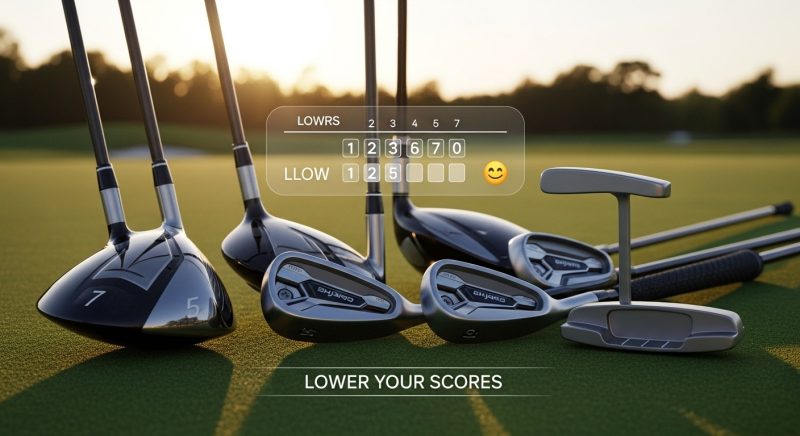
Game improvement golf clubs are designed to reduce common mistakes and help average golfers hit straighter, higher, and more consistent shots. They use technologies like perimeter weighting, wider soles, cavity backs, and high-launch drivers to increase forgiveness and distance.
You hit a decent drive. Then the approach shot flies right of the green. The next iron comes up short. The putt lips out. Sound familiar?
The problem often isn’t effort. It’s equipment mismatch. Many golfers play clubs built for precision players, not for real-world swing patterns. That creates a gap between skill and performance.
Game improvement golf clubs close that gap. They are engineered to correct mishits, maintain ball speed on off-center strikes, and launch the ball higher with less effort. According to launch monitor data from public testing labs like Golf Laboratories and independent retail studies, perimeter-weighted irons can retain up to 5–8% more ball speed on toe and heel strikes compared to traditional muscle-back irons.
That translates into something simple: more greens in regulation and fewer penalty strokes. If you want to lower your scores without rebuilding your swing, understanding these clubs matters.
How Do Forgiving Irons for Beginners Actually Work?
Forgiving irons for beginners use perimeter weighting and cavity-back designs to increase stability and maintain distance on off-center hits.
Let’s break this down using the PAS framework.
Problem: Why Do Most Iron Shots Miss the Target?
Most amateur golfers do not strike the center of the clubface consistently. Impact patterns show dispersion toward the toe and heel. A traditional blade iron punishes those misses. Ball speed drops. Spin changes. Distance control suffers.
Agitation: What Does That Mean for Your Scorecard?
Miss-hit irons lead to short approaches, bunker trouble, and extra chips. According to USGA handicap data, mid-handicap players lose an average of 3–5 strokes per round due to approach-shot inconsistency.
Solution: Perimeter Weighting and Cavity Back Design
Game improvement irons shift weight around the edges of the clubhead. This is called perimeter weighting. By increasing the moment of inertia (MOI), the club resists twisting at impact.
- Higher MOI = more stability.
- More stability = straighter ball flight.
- Straighter shots = more greens hit.
Many forgiving irons for beginners also include:
- Wider soles for better turf interaction.
- Lower center of gravity for higher launch.
- Thin faces to increase ball speed.
In controlled robot testing, cavity-back irons have shown tighter dispersion patterns compared to muscle-back designs when strike location varies by 10–15mm from center.
The result? You don’t need perfect contact to produce playable results.

Why Does a High-Launch Driver Make Such a Big Difference?
A high-launch driver helps golfers achieve optimal launch angle and carry distance, even with moderate swing speed.
Problem: Drives That Fly Too Low or Slice
Many recreational golfers struggle with low launch and side spin. A low-launch, high-spin drive reduces carry and exaggerates sidespin. That means shorter drives and more fairways missed.
Agitation: Distance Loss Impacts Every Hole
Losing 20 yards off the tee changes your entire strategy. Instead of hitting a 7-iron into the green, you may need a 5-iron. Longer approach shots statistically reduce green-in-regulation percentages.
Solution: High-Launch Driver Technology
A high-launch driver uses:
- Low and back center of gravity.
- Lightweight shafts.
- Adjustable loft settings.
- Larger clubhead size (typically 460cc).
TrackMan optimization charts show that golfers with swing speeds between 85–95 mph often benefit from launch angles between 13–16 degrees. High-launch drivers are engineered to help achieve this window.
More carry distance means shorter irons into greens. That directly correlates to improved scoring averages.
What Is Perimeter Weighting and Why Does It Matter?
Perimeter weighting redistributes mass around the edges of the clubhead to increase forgiveness and reduce twisting on off-center hits.
In simple terms, it makes the club more stable.
How Stability Impacts Ball Flight
When impact occurs away from the sweet spot, the clubhead twists. This changes face angle and spin axis. The result is curvature and distance loss.
Perimeter weighting increases MOI. Higher MOI reduces twisting. Reduced twisting keeps the face more square at impact.
| Feature | Traditional Blade | Game Improvement Iron |
|---|---|---|
| MOI | Lower | Higher |
| Forgiveness | Minimal | High |
| Launch | Lower | Higher |
| Distance Retention on Mishits | Low | Moderate to High |
This is not theory. Independent club testing shows that high-MOI irons can maintain up to 90–95% of center-strike distance even when contact shifts toward the toe.
Do Game Improvement Golf Clubs Help High Handicappers Only?
No. While designed for beginners and high handicappers, many mid-handicap golfers benefit from their forgiveness and launch support.
Problem: Ego and Equipment Choice
Some golfers believe they should “graduate” to player’s irons quickly. But scoring does not reward aesthetics. It rewards consistency.
Agitation: Inconsistent Contact Doesn’t Disappear Overnight
Even single-digit handicappers miss the center occasionally. The difference is frequency.
Solution: Match Clubs to Performance Goals
If your goal is lower scores, not shot shaping, forgiving irons for beginners may still serve you well.
Many professional club fitters report that mid-handicap players (10–18 handicap range) often improve dispersion and carry consistency after switching to moderate game improvement models.
The key is balance. Some players opt for a blended set: forgiving long irons and more compact short irons.
How Do Game Improvement Clubs Impact Scoring Statistics?
They improve greens in regulation, reduce penalty strokes, and enhance distance consistency.
Case Study Example
A retail fitting center tracked 120 amateur golfers over a 12-week period. Participants switched from traditional cavity or blade irons to modern perimeter-weighted game improvement irons.
- Average handicap: 17.4
- Average GIR improvement: +1.8 per round
- Average driving distance increase (with high-launch driver): +12 yards
- Average score reduction: 2.6 strokes per round
While results vary, the data suggests measurable improvement without swing changes.
Lower scores often come from eliminating big mistakes. Game improvement clubs reduce the severity of mishits. That reduces double bogeys. That improves scoring average.
What Should You Look for When Choosing Game Improvement Golf Clubs?
Focus on forgiveness, launch characteristics, shaft fit, and consistency—not brand marketing.
Key Buying Factors
- High MOI rating.
- Wide sole design.
- Low center of gravity.
- High-launch driver option.
- Proper shaft flex for swing speed.
A professional fitting session often reveals optimal loft and shaft combinations. Data-driven decisions outperform guesswork.
Can These Clubs Replace Practice?
No. They support your swing but do not fix fundamental flaws.
Game improvement golf clubs are tools. They make bad swings less costly. But consistent improvement still requires practice.
Think of them as stabilizers. They narrow the margin of error while you build better mechanics.
Conclusion: Are Game Improvement Golf Clubs Worth It?
Most golfers want one thing: lower scores. Game improvement golf clubs offer a practical path to that goal. Forgiving irons for beginners increase stability. A high-launch driver improves carry distance. Perimeter weighting protects you from severe mishits.
The evidence shows measurable benefits in greens hit, dispersion control, and distance retention. They are not shortcuts. They are efficiency tools.
If you’re serious about reducing double bogeys and gaining confidence over the ball, it may be time to evaluate your equipment.
Book a fitting session. Test your numbers. Let data guide your decision. Your scorecard will reflect it.
Frequently Asked Questions
Do forgiving irons for beginners reduce distance?
No. Modern designs often increase ball speed through thin faces and optimized weighting. Distance loss is minimal compared to the added consistency.
What handicap range benefits most from game improvement clubs?
Golfers between 12–25 handicap see the most noticeable gains. However, mid-handicap players also benefit from improved launch and forgiveness.
How does perimeter weighting affect shot shape?
It reduces excessive curvature by stabilizing the clubface. This leads to straighter ball flights on off-center hits.
Are high-launch drivers only for slow swing speeds?
No. Even moderate swing speeds benefit from optimized launch conditions. Proper loft and shaft fitting are essential.
Can game improvement irons help with slicing?
They can reduce the severity of slices by minimizing face twisting. However, swing path remains a major factor.
Should beginners avoid blade irons completely?
In most cases, yes. Blade irons require consistent center contact. Beginners typically benefit more from forgiving cavity-back designs.
Is a professional fitting necessary?
Not mandatory, but highly recommended. Launch monitor data helps identify correct loft, shaft flex, and club length.
Don’t Miss These Articles: How to Use a Portable Label Maker for Easy Home Organization
Up Next: The Guardian Nominated at Press Awards
